5 Weighted IV Poles That Won’t Tip Over on High-Pile Hospital Carpeting

I’ll never forget the sound of three infusion pumps screaming in unison as a standard-issue IV pole started its slow, agonizing tilt toward the floor. It was in the newly renovated oncology wing—a place designed for peace, quiet, and apparently, the absolute destruction of medical equipment. The facility had installed beautiful, high-pile carpeting to dampen the noise. It looked great. It felt great underfoot. But for my equipment? It was quicksand. I was moving a patient for a quick walk when a single caster snagged in the fibers, and the whole top-heavy rig lurched. I caught it mid-air, straining my shoulder in the process, but the terror of nearly dropping $15,000 worth of life-saving tech never really left me.
Why Lush Hospital Carpets Are Secretly Dangerous for Your Gear
We often prioritize patient comfort—as we should—but we rarely think about how upgrading medical equipment needs to account for the actual environment it lives in. Standard poles are usually top-heavy by nature. When you add thick carpeting into the mix, you increase rolling resistance significantly. According to a study published in the Journal of Hospital Medicine, while high-pile carpets are excellent for noise reduction, they can increase the force required to move wheeled medical stands by nearly 50% compared to hard flooring. This creates a pivot point at the base that leads to tipping. Early in my career, I made the mistake of thinking I could just ‘be careful’ with the cheaper, lightweight aluminum models. I was wrong. You need a low center of gravity and specific caster diameters to survive the ‘plush’ wards. If you’ve been struggling with wobbly equipment, you might also want to look into infusion pump stands that won’t wobble during those critical moments.
Won’t a Weighted Base Just Be Too Heavy for Nurses to Push?
This is the first thing everyone asks me. They worry that adding 20 or 30 pounds of dead weight to the base will turn a simple walk into a gym workout. In reality, it’s the exact opposite. A properly weighted base provides the momentum needed to glide over those carpet fibers rather than getting hung up on them. It’s about stability, not just bulk. When you use heavy-duty IV poles designed for high-stress environments, you’ll find they actually track straighter. Today, I’m going to show you exactly which five poles have saved my sanity (and my back) on the thickest carpets in the business. Have you ever had a ‘near-miss’ where a pole almost tipped over on a rug? Tell me about it—I bet I’ve been there too. Let’s make sure it never happens again by picking the right reliable medical devices for your specific floor plan.
How a Low Center of Gravity Stops the Tip
Think of an IV pole like a sailboat. If all the weight is in the sails—your pumps and monitors—and none is in the keel, the first ‘gust’ of resistance from a carpet edge will capsize you. When you are upgrading medical equipment, you have to look for bases that weigh at least 25% of the total projected load. I remember a chaotic Tuesday in the cardiac unit where we tried to use a standard six-leg base with three stacked pumps. Every time we crossed the threshold of a carpeted patient room, the pole would bow forward like it was taking a final curtain call. We eventually swapped to heavy-duty IV poles with cast-iron bases. The difference was immediate; it felt like the equipment was finally anchored to the earth rather than hovering precariously above it.
Bigger Wheels Glide Through Thick Fibers
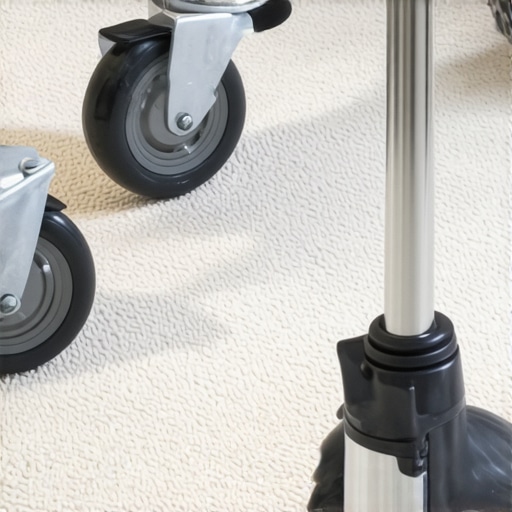
Small wheels are the natural enemy of plush flooring. A two-inch caster on a high-pile carpet is essentially a shopping cart in a sand pit. It doesn’t roll; it plows. To maintain mobility, you need at least 3-inch or ideally 4-inch casters with a harder rubber durometer. This prevents the wheel from ‘sinking’ into the carpet fibers while the patient is moving. If you’ve noticed your team struggling with momentum, it’s likely because the wheels are too small to stay on top of the pile. Using infusion pump stands that won’t wobble often comes down to this simple mechanical advantage: larger surface area equals less sinking.
Balance Your Load Like a Tetris Master
The biggest mistake I see in the field is ‘top-loading.’ We naturally want to put the screens at eye level, but that moves the center of mass dangerously high. I once saw a nurse mount a heavy monitor at the very top of a slim pole to make it easier to read during a code. As soon as she hit the rug in the hallway, the top-heavy momentum carried the pole right over. Now, I teach a strict ‘heavy-low’ rule. Place your heaviest medical supplies and pumps as low as comfortably possible. This lowers the tipping point and makes the entire rig much easier to pivot. When you’re dealing with infusion pump stands that won’t wobble during emergency transport, the internal weight distribution is just as important as the external base.
Run the Friction Snag Test Before the Patient Arrives
Before you commit a piece of equipment to a specific ward, you need to perform a ‘dry run’ on the actual flooring. I call this the Friction Snag Test. Push the empty pole at a normal walking pace and abruptly stop. If the top of the pole continues to move more than two inches forward after the base has stopped on the carpet, it’s a tip hazard. I once failed an entire fleet of new monitors using this test, and the administration was furious—until I showed them how easily the poles folded on the new rugs. We ended up sourcing affordable medical devices with wider leg spans that specifically passed the snag test. It’s a five-second check that prevents a five-figure repair bill later.
I’ve spent years watching clinics sink money into ‘smart’ solutions that end up collecting dust because they’re too complex for a high-stress environment. Everyone says that when upgrading medical equipment, you should always go for the latest AI-integrated models with the longest feature lists. In my experience? That’s a fast track to staff burnout and equipment failure. The real pro move isn’t about finding the device with the most processors; it’s about ‘Human Factors Engineering’—how the tool actually fits the hand and the workflow when everything is going wrong. 
Stop Chasing Shiny Objects and Start Testing Workflow
The ‘Oops’ factor I see most often is what I call the Feature Creep Trap. Hospitals buy latest medical equipment technologies that promise to do everything from monitor vitals to predict weather patterns, but the interface is so cluttered that a nurse can’t find the ‘Silence Alarm’ button in the dark. A 2024 report by the Human Factors and Ergonomics Society highlighted that medical errors significantly increase when a device’s cognitive load—the mental effort required to operate it—exceeds a certain threshold during emergencies. If you’re looking for reliable medical devices, look for the one with the fewest clicks to get to the primary function. If it takes a three-level menu to start a simple infusion, that device is a liability, not an asset.
Why ‘Smart’ Tech Often Fails the Reality Check
We’ve been conditioned to think that ‘software-driven’ equals ‘better.’ But in the world of medical devices innovation, the physical build often matters more than the code. I once consulted for a clinic that bought top-of-the-line wireless monitors that looked like something out of a sci-fi movie. The problem? The charging docks were so flimsy that they broke within three weeks of heavy use. They had spent $50,000 on software but $0.50 on the plastic housing. When you’re upgrading medical equipment, you have to look past the touchscreen and check the hinges, the ports, and the battery doors. Those are the parts that actually break.
Does Your Equipment Actually Respect the Laws of Physics?
This is the question that separates the veterans from the novices. A device can have a beautiful 4K screen, but if the wheelbase is too narrow, it’s going to tip the first time a janitor bumps it with a floor buffer. We saw this with many infusion pump stands that won’t wobble on uneven hospital floors—the secret wasn’t digital stabilization; it was simple, heavy-duty engineering. Don’t let a salesperson distract you with cloud-syncing capabilities if the device can’t survive a 3-foot drop or a splash of saline. Have you ever fallen into this trap of buying a ‘smart’ device that turned out to be physically fragile? Let me know in the comments—I’d love to hear your horror stories so we can help others avoid them.
Maintenance is the unglamorous part of the job that everyone ignores until a wheel falls off in the middle of a code or a battery fails during a critical transfer. I’ve seen clinics lose thousands of dollars because they treated their tech like a ‘set it and forget it’ appliance. The truth is, high-use equipment requires a pit-crew mentality. I personally carry a small maintenance kit in my locker—a high-grade silicone lubricant for casters and a precision torque wrench for tightening base bolts. It sounds obsessive until you’re the one moving a patient without the gear rattling like a bag of loose change.
Keep Your Fleet Rolling for a Decade
If you want to scale a clinic without going broke, you need a proactive system. For example, knowing how to optimize medical supplies inventory for better efficiency saves more money than any bulk discount ever could. I’ve transitioned most of my consulting clients to a ‘digital twin’ system. Every piece of heavy-duty gear gets a QR code. When a nurse notices a slight wobble, they scan it, and the maintenance ticket is live before they even leave the room. This prevents the small issues from becoming catastrophic failures. When you are upgrading medical equipment, you aren’t just buying the steel; you’re buying a lifecycle. If the manufacturer doesn’t provide easy access to replacement casters or gaskets, I don’t buy it.
How do I keep my gear running like new after 5,000 shifts?
Consistency beats intensity every single time. You don’t need a deep overhaul every month; you need a five-second ‘feel’ test every week. I check for three things: smoothness of the glide, the ‘click’ of the locking mechanism, and the integrity of the power cord housing. It’s the same logic I use when picking 5 surgical scissors that actually stay sharp after 50 sterilization cycles—you look for the stress points. According to the ISO 13485:2016 standard, maintaining rigorous records of device performance is a regulatory must, but from a floor perspective, it’s just common sense. If you aren’t tracking the ‘mean time between failures,’ you’re just waiting to be surprised by a breakdown.

Look Out for Sensors That Predict Their Own Failure
The next big shift in medical devices innovation isn’t going to be a new screen; it’s going to be predictive telemetry. We are already seeing the first wave of ‘smart bases’ that alert the central station when a caster is losing its durometer or a battery cell is dipping below its optimal charge curve. This is a game-changer for choosing reliable medical devices because it removes the guesswork. We are moving toward a world where your IV pole tells you it needs a new wheel before it ever has the chance to tip over on a carpeted floor. My advice? Try the ‘One-Month Hinge Check’ on your heaviest equipment this week. Tighten every visible screw and lubricate every joint. You’ll be shocked at how much ‘newer’ your old gear feels after just twenty minutes of basic care.
Hard Lessons I Learned on the Oncology Wing Floor
After a decade in the trenches, I have realized that the most expensive piece of tech is worthless if it cannot cross a rug safely. Here are the lightbulb moments that changed my approach to clinical safety:
- Physics does not care about your budget: A cheap, lightweight stand is a liability on a plush floor, no matter how many features it has. I have learned that affordable medical devices only save money if they actually stay upright during a patient transfer.
- The Silent Fail is the deadliest: Equipment rarely breaks all at once. It is the slow loosening of a base bolt or the drying of caster grease that leads to a tip. Catching these early is the mark of a true pro.
- Staff feedback is your best metric: If the nurses are complaining that a pole is too heavy, they usually mean it is hard to steer. This is almost always a wheel diameter issue, not a weight issue.
My Go-To Toolkit for Clinical Stability
When I am vetting new gear for a facility, I do not just read the brochure. I look for specific build qualities that withstand daily abuse. For high-pile areas, I always recommend looking at heavy-duty IV poles because their cast-iron bases are non-negotiable for safety. Beyond the hardware, I rely on the ISO 13485 standards for maintenance scheduling. To keep everything organized, mastering how to optimize medical supplies inventory for better efficiency is the only way to ensure replacement casters are always in stock before a crisis hits.
The Future of Your High-Stability Facility
Choosing the right equipment is not just a line item on a budget; it is a commitment to the safety of your patients and the sanity of your staff. As you move forward with upgrading medical equipment, remember that the best tools are the ones that disappear into the workflow. You deserve gear that works as hard as you do, regardless of how thick the carpet is. Let us build a safer, more stable environment together by prioritizing physics over flashiness. Have you ever had a piece of equipment fail simply because of the flooring? Let me know your stories in the comments below!